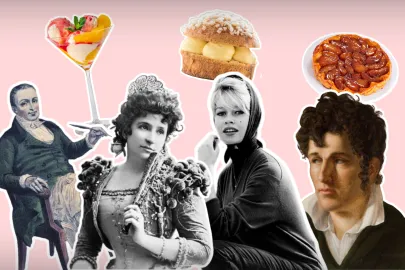
It’s no myth that the French love talking about food! So much so that it has become a source of inspiration for countless everyday French expressions. So, don’t be too surprised if someone starts talking about being in the pâté, there’s more to these expressions than meets the eye.

Fruit, vegetables, wine, cheese and more: French food vocabulary has found its way into everyday language in some surprisingly creative ways. With so many phrases to choose from, we couldn’t cover them all without turning this into a whole book. So, here are a few of our favourites:
En faire tout un fromage (“to make a whole cheese out of it”)
This means making a big deal out of something small or turning a minor issue into a whole drama. The expression is a playful culinary metaphor: after all, turning something as simple as milk into a finished cheese is a long process that takes quite a bit of work and transformation. So, if you “make a whole cheese out of it”, you’re making something much more complicated than it was at the start.
Avoir la pêche (“to have the peach”)
If you’re “having the peach” in France, you’re actually feeling great, full of energy and ready to take on the day! The expression is thought to come from the world of boxing, where une pêche (peach) was slang for a powerful punch. Having de la pêche meant having strength and power, a meaning that eventually evolved into being full of vitality and dynamism. You might also hear the equally popular version “avoir la patate” (“to have the potato”) or even “avoir la frite” (“to have the chips”), which means exactly the same thing: to be on top form and full of energy!
Se faire du blé (“to make wheat”)
In everyday French, “se faire du blé” has nothing to do with farming ; it means to make money! The expression dates back to the mid-19th century, when blé (“wheat”) became popular slang for money. The connection comes from rural life: wheat was a fundamental source of food and a symbol of wealth, so having a plentiful harvest meant having plenty of resources.
Se fendre la poire (or to split one’s pear)
This means that you are laughing your head off. In 19th-century French slang, poire (“pear”) was used to mean face. The expression became popular after a famous 1832 caricature of King Louis-Philippe, which depicted him with a pear-shaped face. And there’s another possible explanation: when we laugh, our face can stretch into a shape that vaguely resembles a pear!
Mettre de l’eau dans son vin (“to put water in your wine”)
This French expression means to tone things down. It comes from the ancient practice of diluting wine with water to make it milder and less strong (quite like adding water to your coffee when making an Americano, if we’re looking for a modern comparison!). By the 16th century, this literal practice had taken on a figurative meaning: “putting water in your wine” came to mean to soften your words or attitude. But beware, actually diluting your wine today would be a serious breach of wine etiquette!
Ramener sa fraise (“to bring your strawberry”)
Ever been told to keep your strawberry to yourself? This means to butt into a conversation or show up somewhere uninvited. Dating back to the early 20th century, it comes from the slang use of fraise (“strawberry”) to mean face or head, a twist to the pear if you will. So, ramener sa fraise literally means “to bring your face along” and eventually came to describe someone turning up or sticking their nose into a conversation when they weren’t necessarily expected. Sadly, no charlottes aux fraises involved... You're just bringing your face along, invited or not.
Être dans le pâté (“to be in the pâté”)
If you’re “dans le pâté”, you’re probably not feeling your best! This French expression means to be very tired or even hungover. You can also say “avoir la tête dans le pâté” (literally, “to have your head in the pâté”). The expression is based on the heavy and compact texture of pâté, which became a metaphor for that sluggish feeling when your mind feels heavy and you’re struggling to function after a short night or a little too much to drink. And when you're really dans le pâté, the French have the perfect remedy: a good bowl of onion soup, guaranteed to bring you back to life!
La moutarde me monte au nez (“the mustard is rising to my nose”)
If you say “la moutarde me monte au nez”, you’re starting to lose your patience. The expression comes from a very literal sensation: when you eat strong mustard, its sharp compounds quickly rise into your nose, making it tingle and sometimes bring tears to your eyes. This sudden rush of irritation became a vivid metaphor for anger building up inside you. The expression dates back to the 16th century, when it was first phrased as “la moutarde lui entre au nez” (literally, “the mustard enters his nose”). Don't worry though, mustard won't always get the better of you: whisked into a vinaigrette for instance, it's nothing but a delicious addition to your salad.
Raconter des salades (“to tell salads”)
Speaking of salads, when you hear someone saying this, they’re not talking about lunch! This means to tell lies or spin a story to fool or entertain someone. Dating back to the 19th century, it draws on a culinary metaphor: just like a salad mixes different ingredients into one dish, a good lie can be a clever mix of truth, fiction, exaggeration and humour, all put together to make a story easier to “swallow”. And when a situation gets unnecessarily complicated or blown out of proportion, you can also say “en faire toute une salade” (literally, “to make a whole salad out of it”).
Pleurer comme une madeleine (“to cry like a madeleine”)
Someone's got to be cutting onions somewhere, because this expression means you're crying your eyes out. You probably pictured the delicious French pastry when you first read this phrase, but it actually has nothing to do with food, a fact most French people don't even know! Here, “madeleine” refers to Mary Magdalene, who, according to the Bible, washed Jesus' feet with her tears.
Bonus fact: the term "madeleine de Proust" also exists in French, this time referring to the actual pastry, and used to describe something nostalgic. It comes from Proust's novel In Search of Lost Time, in which the narrator dips a madeleine into his tea, suddenly unlocking a flood of childhood memories.
Ça passe crème (“It goes like cream”)
When something says “ça passe crème”, it means that everything is going smoothly. This French expression draws on the smooth, silky texture of cream, which spreads effortlessly without resistance. It’s similar to the older expression “comme dans du beurre” (literally, “like in butter”) used to describe something that happens with ease. Emerging in the early 2000s in young people’s slang, “ça passe crème” has since become widely used in everyday French.
Ramener son grain de sel (“to bring your grain of salt”)
If you "bring your grain of salt," you're butting into a conversation or situation to give your opinion when nobody asked for it. The expression comes from the culinary idea of adding a little salt to a dish: as a finishing touch, a bit of salt adds great flavour, but too much can ruin it. Just like an unwanted opinion can be an unwelcome addition to a conversation.
Now that you’ve got a taste of these expressions, you’re ready to spice up your French conversations. Just don’t make a whole cheese out of it if you slip up!
Contributor
Emma Caron
Food blogger
On the same subject




Most popular this week