My French Madeleine: Sommelier Honey Spencer’s Dreams of Ardèche
Sommelier extraordinaire (Eurostar), restaurateur (Sune) and author (‘Natural Wine No Drama’, Pavilion Books), Honey Spencer wears many hats and a deeply-rooted love of France. For Taste France Magazine, she flicks through cherished memories of childhood summers in the Ardèche returning years later with her own family and making joyful winemaker discoveries along the way.

I can’t recall a chapter of my life in which I haven’t visited France at least twice a year. My parents, having travelled extensively before I was born, decided, quite conveniently, that France represented the very best of what the world had to offer. And so that country became the backdrop of my childhood and early adulthood.
There were summers spent in the South: the thrumming markets of Perpignan and Collioure; the endless purple and yellow-stained fields of the Luberon. There were French exchange programmes to Toulon (to improve my French, though I suspected my parents were really training me to haggle over antique pastis bottles at local bric-à-brac markets); a few lucky ski trips in the Alps. And of course, Paris, that utterly perfect pearl of a city. As a teenager I arrived by Eurostar in search of macarons and the world’s best chocolat chaud (before queuing for Angelina’s was yet a blood sport). Then later, as an Erasmus student living in the city, by which time my passions had narrowed to those I considered chicer and more sophisticated: sitting in cafés sipping noisettes (France’s answer to macchiato) and attempting in a rather lackluster fashion to find a French boyfriend.
Yet for all my youthful ferreting around France, there was one place which stood above the rest: the Ardèche Valley. I adored the endless pine forests and the crispness they brought to the air, even in the height of summer; the winding gorges and ancient villages tucked into their curves. It was there that I learned I prefer swimming in fresh water to the sticky, saline pull of the sea, floating in the crystalline gorges beneath limestone cliffs. It was there I tasted my first glace aux marrons (Ardèche’s signature ice-cream made of local Ardèche chestnuts PDO) from a local glacier in Vallon-Pont-d’Arc.

An early morning raid of the local market fromagerie sparked a lifelong devotion to goat’s cheese via Picodon PDO, the region’s proudly appellation-protected expression: soft and creamy in youth, increasing in capric energy with age, resulting in the signature chèvre snap and spice. The Ardèche bugne, also known as oreillette, I discovered, was a sort of doughnut, sometimes crisp, sometimes soft, dusted with sugar and eaten with childlike abandon. In the years that passed since my summer there, I developed a quiet fantasy of returning one day with a family of my own.
Back then, wine barely registered. As much as I would have loved to be one of those children who were given a thimble of wine topped up with water at dinner, my own understanding extended no further than my parents’ bag-in-box purchases, permanently installed on the top-left shelf of the fridge at home. It wasn’t until many years after I had trained as a sommelier that I came to know the wines of my beloved Ardèche.
For any sommelier, an appreciation of the Rhône Valley is essential, and I reveled in the distinctions between the muscular, inky Syrahs of Côte-Rôtie PDO forged from the likes of Yves Gangloff; the age-worth intensity of Cornas PDO reds encapsulated in bottle so perfectly by Thierry Allemand and Franck Balthazar, and the comparably playful Saint-Joseph expressions of René-Jean Dard and François Ribo. Yet stepping slightly aside from the Rhône’s more codified appellations brings you into the Ardèche: a region whose wines are often grouped under the banner of Ardèche IGP, or occasionally Côteaux de l’Ardèche (and even Côtes du Rhône, or Côtes du Rhône Villages).
© Honey Spencer
Geographically and geologically, the Ardèche is wonderfully complex. Vineyards are scattered across steep slopes and high plateaux, rooted in limestone, marl, granite and sandy soils, often surrounded by chestnut forests, garrigue and wild herbs. Warm Mediterranean days are tempered by altitude, forest cover, and the cooling influence of the Massif Central, lending freshness and definition to the wines. Controversial as it may be, it is the wines labelled Ardèche IGP which I found to bring me the purest joy. Free from the stylistic expectations of its stricter neighbouring appellations, these wines often feel more immediate and expressive: generous in fruit, shaped by their soils, and guided by thoughtful, hands-on farming.
Twenty years after my first visit, I finally returned, this time with my husband Charlie and our three-year-old Len. We took the train from Paris to Avignon, hired a car, and wound our way north through Châteauneuf-du-Pape, Tavel and Lirac before finally arriving at Vallon-Pont-d’Arc, the place I had visited so often in memory. This visit, I was determined to seek out every good bottle I could find.
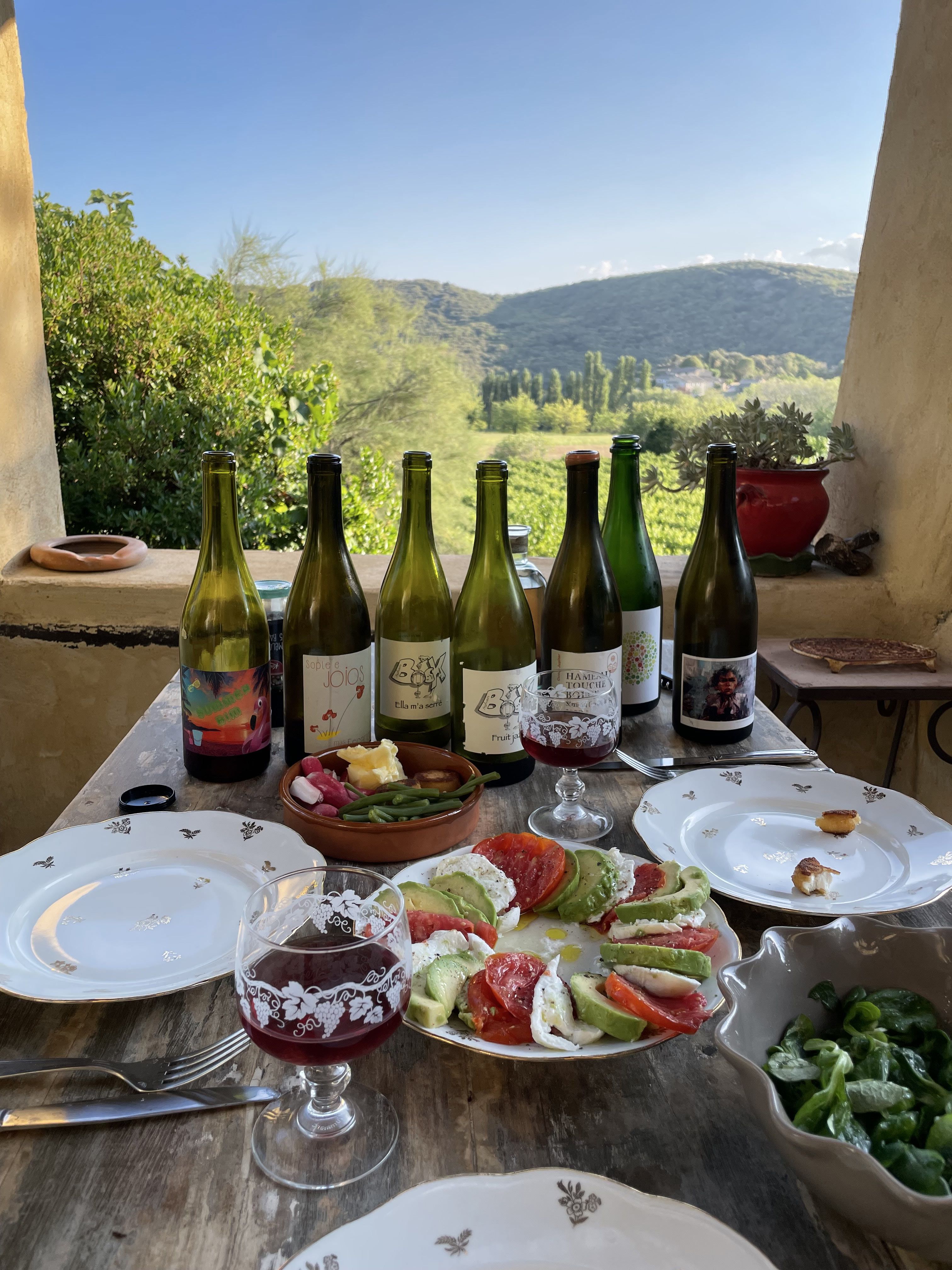
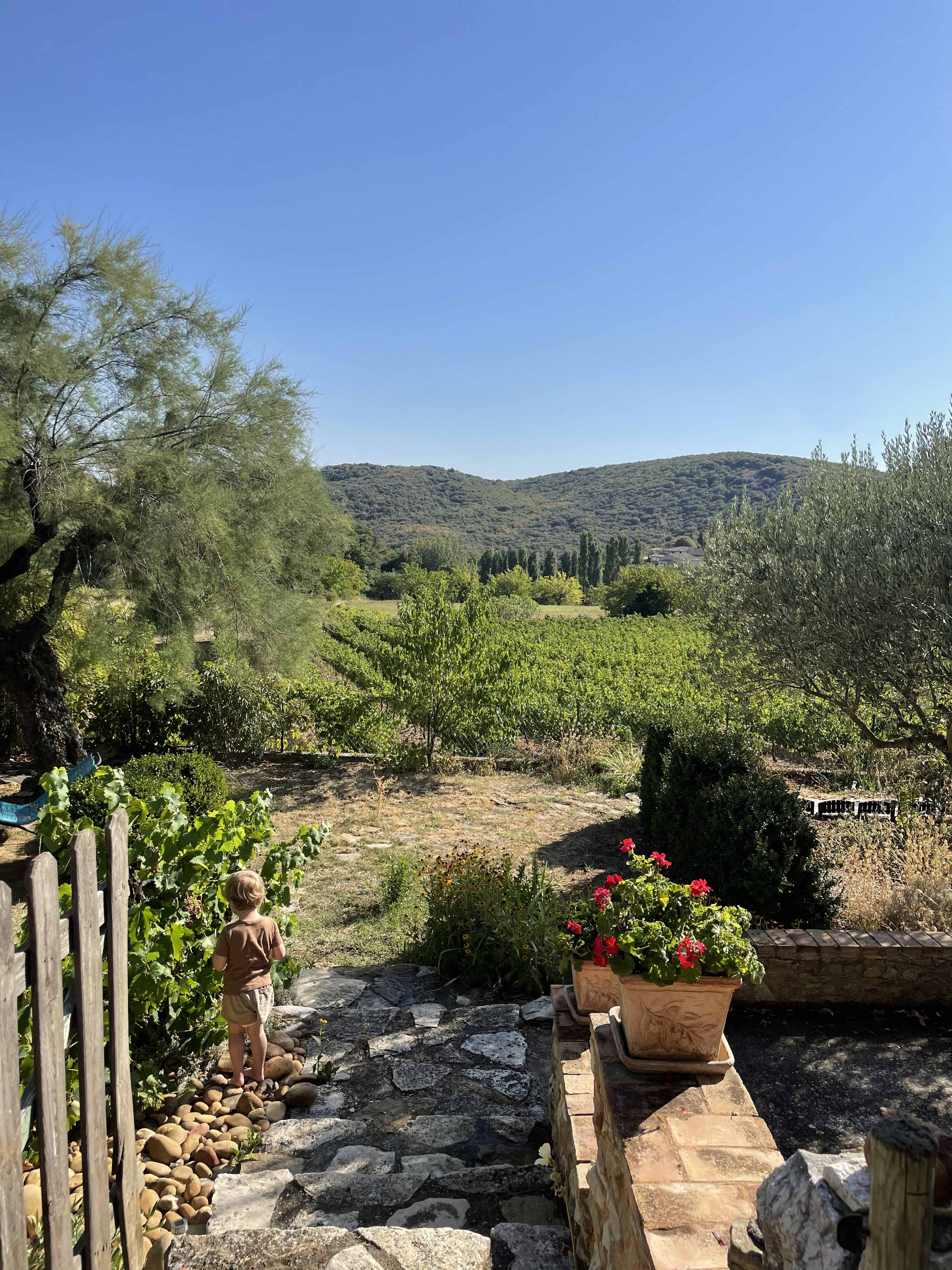
A tip-off via the Raisin app led us to the home cellar of caviste Marion Poulain of Des Racines Aux Verres, who curated two cases of wines from local Ardèche producers I had yet to taste, destined for long, lazy evenings at our rented holiday cottage overlooking vineyards planted with Grenache. Through Marion, I discovered the wines of Sylvain Bock and Jérôme Jouet, whose bottles demonstrated the perfect balance of freshness and depth. I was also introduced to Domaine de l’Alezan, a producer I would come to understand as emblematic of the Ardèche’s artisanal spirit. As with many vignerons of the region, there are no tractors used; the vines are worked entirely by hand or with the help of a horse; treatments are applied using backpacks; and soils are tended with pickaxe or plough. The resulting wines feel grounded and assured, shaped as much by care and effort as by the terroir from which they are sculpted.
© Honey Spencer
In search of a decadent lunch, we stumbled upon L’Espousse, a tiny bistrot tucked into the crevices of Pont-d’Arc village. Almost hidden from street view, this is a place worth seeking out. Sitting in the dining room cut out of the limestone of the village, L’Espousse summarised everything I love about the Ardèche and its devotion to simple pleasures: local ingredients caught in their perfect window and assembled with sensitivity and served alongside a cellar of the best bottles the Ardèche can muster.
Further exploration revealed other growers: Jean Delobre of Les Cigales dans la Fourmilière, La Ferme des Sept Lunes in the northern Ardèche, Domaine du Mazel, and Yann Rocher, each contributing to a compelling mosaic of styles united by careful stewardship of the Ardèche terroir and its signature playful spirit.
It is these bottles, dishes and landscapes that tether me permanently to the Ardèche, a place that has grown alongside me, from childhood wonder to adult admiration. I long for it to remain as it is now: wild, independent, generous of heart. A region that rewards curiosity over curriculum, and where I hope my children will one day take their own to float in the same clear waters and dream a dream of their own beloved Ardèche, perhaps accompanied by a thimble of wine.
Ardèche Wines: Honey's Pairing Tips 🍷
White Ardèche wine
Domaine de l’Alezan ’Suspens’: a wonderfully textural white made from Marsanne and Roussanne varieties.
🧺 Find it in the UK: Wayward Wines, £46
🧀 Drink it with: a tangy, nutty Picodon PDO goat’s cheese – typical from the region.
Red Ardèche wine
Sylvain Bock’s ‘Raffut’: a perfectly lively Syrah with dark fruit and a decisive crunch.
🧺 Find it in the UK: Beattie & Roberts, £37.50
🌰 Drink it with: a generous rustic slice of game and chestnut pâté.
Contributor
Honey Spencer
Sommelier
On the same subject



Most popular this week